
A Digital Journal - San Francisco Public Works
In the Works

September 2025
On land in downtown San Francisco where factories stood more than a century ago to serve the emerging city, today, crews are at work building a brand-new street from the ground up – a complex and unusual construction project managed by Public Works to support the far-reaching reimagining of the east-side neighborhood.


Jan. 8, 1900, was the day the City of San Francisco officially marked the beginning of the San Francisco Board of Public Works through legislation that would usher in an era of cleaner streets and safer infrastructure for the residents of the City.
Today, we're known as San Francisco Public Works and we continue to provide many of the same programs and services that we did 125 years ago – while facing many of the same challenges.
Take a trip through our history with many rare images from early in the 20th century, which trace the development of Public Works and the City of San Francisco.
FEATURE STORIES


Driving Change: A Busy Corridor Gets a Pedestrian Safety Overhaul
San Francisco’s Sixth Street, with around-the-clock street activity, is one of the most dangerous and deadly corridors for pedestrians due to a high number of traffic-related collisions. But a recently completed makeover of the busy street intends to change that.

Build It and They Will Come!
The newly renovated Stern Grove Playground, tucked amid towering trees just inside the City’s Sigmund Stern Recreation Area, boasts custom-designed play equipment, including climbing nets, timber log features, a nature exploration zone, new lawn areas and structures modeled after tree houses.

#LoveOurCity – No Matter Your Age
A mother-daughter duo was among 69 volunteers who came out for this month’s Love Our City: Neighborhood Beautification Day. The Sept. 6 workday hosted by Public Works brought together community members and our professional crews to clean and green Anza Vista, Russian Hill, NoPa and other District 2 neighborhoods.


Crews smooth out fresh concrete on the new block of East Clementina Street.
BLOCk
PARTY
Brick by brick,
a new block is built in San Francisco
In the heart of the East Cut neighborhood, amid glistening skyscrapers and hulking office towers, San Francisco – a densely populated city that mapped its first street nearly two centuries ago – is setting out to do something unusual: construct a wholly new road and with it an entire city block in a long- established corner of the City.

Aerial view of the East Cut neighborhood.
Tucked between Main and Beale streets, a new block of East Clementina Street is coming to life on land that once housed factories to serve a burgeoning city and more recently a temporary bus terminal.
.jpg)
The broken blue line marks the location of the new city block.
Public Works regularly is involved in building brand-new streets, but usually in large redevelopment areas that are being repurposed. The new Mission Bay neighborhood, for example, sprouted from old rail yards. Treasure Island once served as a naval base and now boasts housing, parks and more. But the building of a fully new block – from sewer to sidewalk – where there was previously no public right of way is an increasingly uncommon endeavor for Public Works, especially in the City’s dense downtown neighborhoods.

Public Works long has been involved in street construction: This 1915 photo shows crews building Sloat Boulevard, near 25th Avenue.
But it is part of the department’s DNA: When Public Works was first created on Jan. 8, 1900, its first task was to organize and regulate street construction and paving projects throughout the City.
“I consider the Department of Public Works of the greatest importance to the City,” said Col. George H. Mendell, one of the department’s first appointed commissioners and an engineer, according to the San Francisco Chronicle’s New Year’s Day edition from 1900. “The health and the material comforts of the City depend upon the proper management of that department and will require much attention and care.”
Once completed, this block of East Clementina Street will serve as a key connector between two major community assets: a new family and senior housing development currently under construction and the site of a future park.
A partnership involving Public Works, the Office of Community Investment and Infrastructure (OCII) and contractor NTK Construction, the East Clementina Street project kicked into high gear during the summer and work is expected to wrap up by spring 2026.
The new one-block stretch is a small, but important, part of the larger, multi-phase Transbay redevelopment effort led by OCII.

Prior to the concrete pour, crews grade the underlying dirt to create a stable surface.
A NEW BLOCK'S BUILDING BLOCKS
So how does Public Works go about building a fully new block?
It starts in the project design phase, when Public Works collaborates with the San Francisco Public Utilities Commission to determine the correct dimensions, location and configuration of key pieces of infrastructure, including curbs, gutters, sewer and water lines, light poles, traffic signals and sewer catch basins.
Crucially, they also figure out how this new block’s utilities will connect to and work within the City’s larger sewer, electrical and water systems.
During the pre-construction period, Public Works’ construction managers and engineers work with our contractor to perform “potholing” in areas that they plan to excavate.
“Potholing” is when crews dig exploratory holes along the project limits to help confirm the depth and alignment of existing underground utilities. Doing so helps us avoid damaging any of these utilities during construction.
On this project, we performed potholing work throughout March.
Once we got the lay of the land, we dug a 9-foot-deep trench down the middle of the block and added a new 12-inch-wide sewer main, 188 feet long. Crews also installed two new manholes.
Christening a new City block
The project reached an exciting milestone on June 11 when the Board of Supervisors officially recognized the new block, designating it East Clementina Street. Like many of the smaller, alley-like streets that run southwest to northeast through SoMa, Clementina Street is a non-continuous street with a few gaps between blocks. Going forward, all blocks of Clementina Street – from First Street to the Embarcadero – will carry the name East Clementina on the City’s official map kept by Public Works.
A month later, crews started construction on the new street’s roadway surface, curbs, gutters and sidewalks.
First, they regraded the area, allowing crews to establish the correct elevations to perform the next step: form the block’s new curbs, gutters and parking strip areas. Much like creating a mold, forming means establishing the shape and area to support the coming concrete pour.

Building new roads and sidewalks is done in stages, including grading, framing and pouring concrete.
Following the first concrete pour, attention shifted to electrical work with the installation of new conduit and construction of the concrete foundation for the streetlight that will eventually service the block’s south side.

Crews pour a new foundation for the coming streetlight.
This month brought more changes to East Clementina Street. After crews compacted and graded the soil, they then were able to pour the concrete for the new sidewalks and roadway on top.

Specialized crews must work quickly to smooth the fresh concrete before it hardens.
Finally, decorative striping using two shades of concrete was added to create a striking visual element and give the new block a distinct look.

The nearly completed new block of East Clementina Street.
BY THE NUM83R5
PUBLIC WORKS
2025 -YEAR TO DATE (through end of August 2025)

7,850
POTHOLES
FILLED

5,994
TREES
PRUNED

834
CURB RAMPS
CONSTRUCTED

401
NUMBER OF BLOCKS RESURFACED

15,150
TONS OF DEBRIS COLLECTED
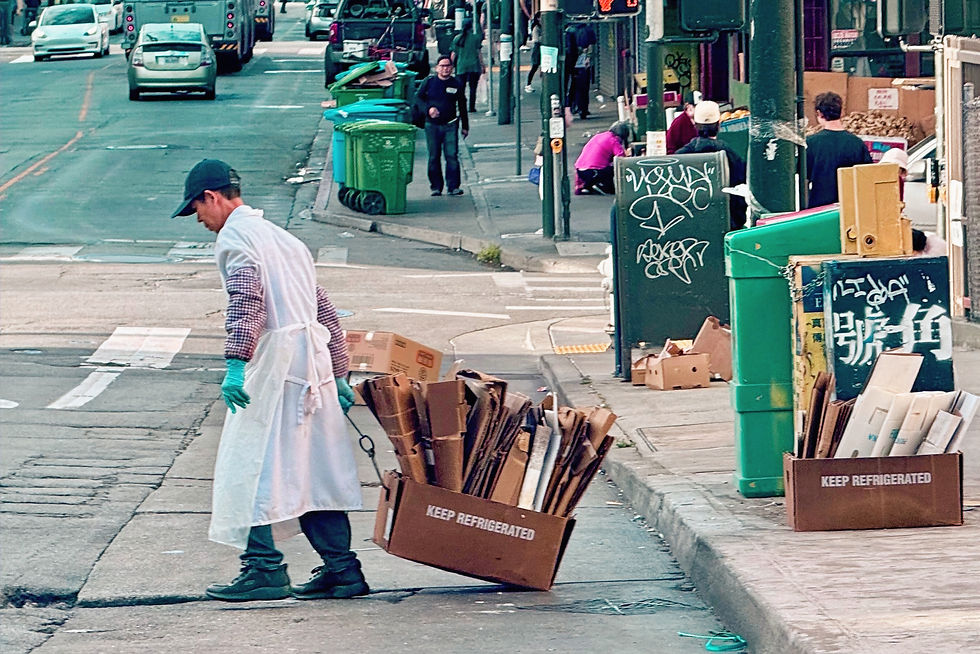
A shop employee, engaged in illegal dumping, drags unwanted cardboard across a Chinatown Street.
Feeling the Sting:
New Operation to
Combat Illegal Dumping
This month, Public Works launched a new undercover sting operation aimed at catching culprits illegally dumping household and business trash in Chinatown – a persistent problem that blights the historic neighborhood.
Dressed inconspicuously as they hung out on a Chinatown sidewalk with an air of nonchalance, a member of the Public Works Outreach and Enforcement Team and our Chinese-language public information officer were on the hunt for bad behavior.
It didn’t take long before the pair spotted a food shop employee hauling bags of trash and cardboard across a street and dumping the garbage on the sidewalk.
Soon after, they caught a worker from another business doing the same.

The illegal dumping sting operation in action, with an undercover Public Works employee keeping a low profile while documenting the bad behavior.
The undercover team caught the offenders on camera and promptly issued citations to the businesses where they work. Fines can run as high as $1,000 for repeat or particularly egregious offenses.
More undercover operations are in the works, not just in Chinatown but in other neighborhoods with known hot spots.
Enforcement action isn’t new. But going undercover gives us another tool to combat illegal dumping.
.jpeg)
Scenes like this in Chinatown are all too frequent, where scofflaw shopkeepers and residents pile trash on the sidewalk.
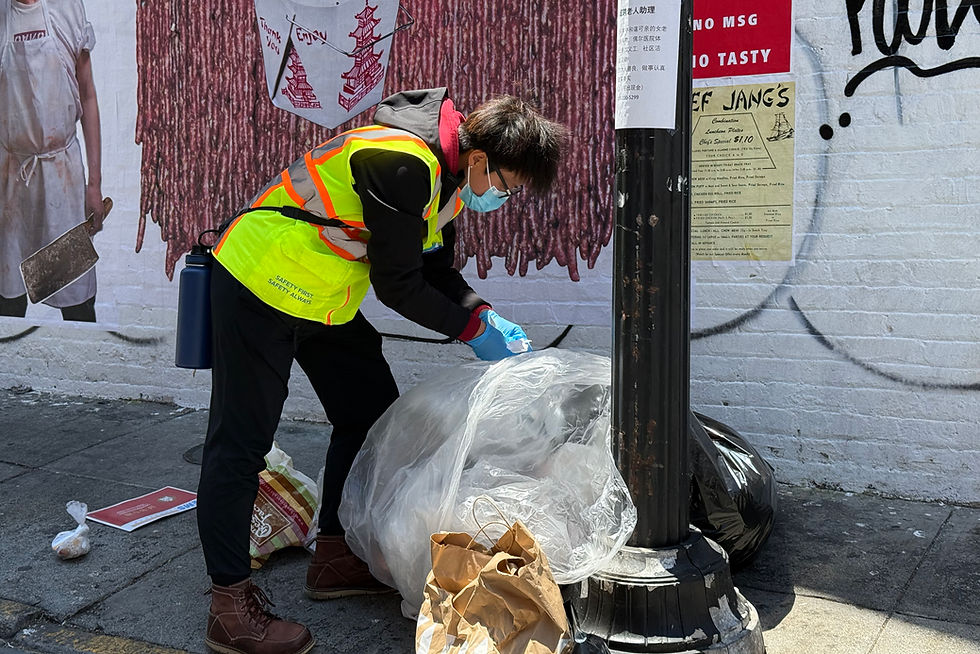
The OnE Team also dons protective gloves and sifts through trash left on the sidewalk and in alleyways, looking for documentation to identify the source of the illegal dumping. Some residents and shopkeepers, fed up with their neighborhood being used as dumping grounds, share surveillance footage of people illegally dumping that we can use to take enforcement action.
Illegal dumping attracts rodents and insects, poses tripping hazards and creates an eyesore that makes the neighborhood a less inviting place for everyone.
.jpeg)
A member of the Outreach and Enforcement Team sifts through garbage looking for identifying information to catch the illegal dumping culprit.
And, unfortunately, the problem isn’t just found in Chinatown or in San Francisco; it’s a global scourge that plagues big cities, small towns and rural areas. In San Francisco, like other jurisdictions, we tackle it on multiple fronts: operational cleanups, enforcement, prevention and public education.
No matter the tactic, the message is the same: Don’t trash our communities.

Public Works crews dismantle a long-standing encampment on state land underneath a South of Market freeway ramp.
Ramping Up for a Cleaner San Francisco
The freeway ramps that touch down in San Francisco should be looking a bit cleaner these days now that a new agreement between Caltrans and the City is in place.
The covenant authorizes Public Works crews to clean up sections of the state highway system, which is Caltrans property. When encampments are present, the City’s multi-department Street Team will engage with the encampment residents and offer services, such as shelter and behavioral health care. The cleaning crews and outreach workers hit the ramps and the parcels underneath the freeways at least twice a week.
The newly inked pact between the City and Caltrans, known as a delegated maintenance agreement, targets eight specific locations, including the 10th Street, 13th Street, Fifth Street, Cesar Chavez Street and Market/Octavia ramps, as well as stretches of San Bruno Avenue and Van Ness Avenue that are part of the state highway system.

Prior to the cleanup, people living in the encampment were given advance notice and offered shelter and services.
At an operation earlier this month, the team was on state land off Dore Street near the 10th Street ramp. There had been a sprawling encampment there for about a year, littered with rotting food, dog and human waste and lots of trash.
As is City policy, the encampment dwellers had been given notice three days ahead of time that crews would be coming through. And they had an opportunity to remove their belongings. Once the outreach was completed, Public Works crews moved in to discard the trash and soiled items. They were careful to follow our bag and tag policy, which governs how items left behind are identified for either disposal or storage.
We know from experience that the cleanups will not be one and done. The City’s unified Street Team will hit the same spots over and over, as needed, with a goal of getting more people into shelter and connected to services.

Public Works crews are part of the City’s multi-department Street Team operation that leads with services.
And when it comes to the less complex issue of tackling litter, unfortunately there’s no quick fix to stop people from tossing their empty coffee cups and candy bar wrappers out their car windows – bad behavior by individual scofflaws that tarnishes the public right of way.
While Public Works crews occasionally had a hand in cleaning the freeway parcels in the past, the process was more cumbersome, requiring us to get Caltrans’ OK in advance. Under the new arrangement, we now can do the work proactively, without prior approval for each operation. Caltrans, which is providing funding to help San Francisco cover the additional labor costs, has signed seven similar agreements with cities throughout the state.

This site, littered with soiled bedding, human and dog waste and rotting food, took crews more than an hour to clean up.
“The first thing you see when you get to San Francisco should be representative of the clean streets we have across the City. Under my administration, City government will no longer tolerate the conditions we’re seeing on our on-ramps and off-ramps — and now we have the tools to fix it,” said Mayor Daniel Lurie.
“Thanks to this agreement with our partners at Caltrans, City departments will take action to deliver safer, cleaner streets for residents and visitors across our city.”

Pedestrians cross Sixth Street by using a new decorative crosswalk.
Driving change: A Busy Corridor
Gets a Pedestrian Safety Overhaul
San Francisco’s Sixth Street, with a mix of dense housing, shops and social services, connects Market Street and I-280 freeway ramps.
And with around-the-clock street activity, it also is one of the most dangerous and deadly corridors for pedestrians due to a high number of traffic-related collisions.
But a recently completed makeover of the busy street intends to change that.
The Sixth Street Pedestrian Safety Project – a collaboration between Public Works and the San Francisco Municipal Transportation Agency – is designed to create a safe and inviting environment for pedestrians, cyclists and motorists by adding wider sidewalks, new traffic signals and other streetscape improvements along the stretch.

A bicyclist rounds a corner along Sixth Street.
Public Works led the design and construction phases of the project, providing project management, engineering, landscape design, construction management and public affairs services.
The upgrades can be found on Sixth Street between Market and Howard streets and at the intersections of Sixth Street and Folsom Street and Sixth Street and Harrison Street.
City officials, including Mayor Daniel Lurie and District 6 Supervisor Matt Dorsey, and community members celebrated the completion of the project at a ribbon-cutting on Sept. 26.

City officials, including Mayor Daniel Lurie and Supervisor Matt Dorsey, and community members cut the ribbon for the project.
“Pedestrians in SoMa, especially families and seniors, often face dangerous conditions on our roads, and this project delivers long-overdue improvements,” Dorsey said. “The combination of safety and accessibility improvements and placemaking is a huge boost to this area.”
In addition to wider sidewalks and signalized pedestrian crossings, the project features new curb ramps, corner bulb-outs – which help shorten the distance pedestrians need to cover when crossing streets – and pedestrian-scale lighting. Crews also completed sewer repair work, street repaving and striping, and they installed street trees, commemorative plaques and decorative paving. Construction began in 2022.
The Public Works landscape architecture team was heavily involved in engaging with the community to design and install decorative crosswalks to honor the SOMA Pilipinas Filipino Cultural Heritage District and the Transgender District – both of which intersect with Sixth Street, between Market and Howard streets.

Part of the Public Works team that worked on the project, along with Director Carla Short. From left to right: Grant Ly, Jesse Blea, Short and Jeffrey Jackson.
“We worked diligently with both districts on the crosswalk designs,” said Public Works landscape architect William Bulkley.
In collaboration with the SOMA Pilipinas group, Bulkley and his team came up with a colorful banig-inspired pattern that can be seen on streets in the middle of the project area. In Filipino culture, banig are traditional, handwoven mats, often used for sitting and sleeping.
To pay homage to and acknowledge the two overlapping districts, the design team proposed a banig pattern with the transgender flag colors at the intersection of Howard and Sixth streets. “This represents not only the overlap of two districts but also the many transgender Filipinos who live and work in the neighborhood,” Bulkley said.

A close-up of a decorative crosswalk with its colorful banig-inspired pattern.
Additionally, crews installed a dozen commemorative plaques along Sixth Street.
The bronze plaques highlight the Transgender District and the Sixth Street Lodginghouse District that commemorates post-1906 worker housing and also covers part of the area.
But what prompted the overhaul and drove the multi-year project were concerns over pedestrian safety. And with good reason.
Prior to the start of the project, Sixth Street had among the highest concentrations of severe and fatal pedestrian collisions in San Francisco: Every 16 days, a person was hit while walking or biking on Sixth Street.
“The whole point of the project is to reduce collisions and ideally eliminate them as a whole along the corridor,” said Public Works Project Manager Jeffrey Jackson who oversaw the project.
“That corridor,” he said, “has different modes of transportation: You have vehicles, you have bikes and you have pedestrians. It was identified as a high-volume pedestrian corridor. There’s a ton of people out there.”

Crews also planted new street trees as part of the makeover.
Collisions have been most concentrated between Market and Howard streets, with half of them involving a pedestrian.
So far, Sixth Street is still included on the City’s High Injury Network, the 12% of City streets identified by the San Francisco Department of Public Health that account for 68% of severe and fatal traffic incidents.
The Sixth Street Pedestrian Safety Project is a key part of the City’s Vision Zero program to reduce traffic deaths and make San Francisco’s streets safer and more accessible for all.
The project is the last of three critical safety initiatives in the area, along with the Better Market Street and Safer Taylor projects – both of which were managed by Public Works during construction.
Following the completion of the Safer Taylor Quick Build project, for example, severe speeding decreased: The number of vehicles traveling faster than 30 mph went down by 31% while the number of vehicles traveling over 40 mph decreased by 94%.
“As stewards of the public right of way, we at Public Works always are eager to find ways to make San Francisco’s streets and sidewalks safer for all who use them,” Public Works Director Carla Short told attendees at the Sixth Street project ribbon-cutting. “And this project aims to do just that.”

The new playground encourages kids to jump, climb, run and explore.
Build it and they will come!
Even before the ribbon was cut to officially open the newly imagined Stern Grove Playground, dozens of kids – from preschoolers to teens – descended on the climbing structures, steppingstones and swings. The ear-to-ear grins and spontaneous hooting and hollering demonstrated in real time the success of the makeover.
The renovated playground, tucked amid towering trees just inside the City’s Sigmund Stern Recreation Area near 21st Avenue and Sloat Boulevard, boasts custom-designed play equipment, including climbing nets, timber log features, a nature exploration zone, new lawn areas and structures modeled after tree houses.
The innovative design, crafted with community input, invites kids to climb, explore and engage in imaginative play, surrounded by the historic park’s natural beauty.

Towering climbing structures, evoking tree houses, stand as the centerpiece of the new Stern Grove Playground.
Prior to the Sept. 10 opening-day celebration, a tremendous amount of work went into replacing the old playground with the new one. The scope included demolition; tree stump removal; removal and disposal of hazardous materials; the placement of new soil and sand; grading, paving, drainage, utility and structural concrete work; and the installation of a new, wooden boardwalk, fencing, landscaping and the irrigation system. Last but not least, crews had to install the one-of-a-kind play structures.
Public Works played a key role in the project, overseeing construction and making sure that the vision for the space was realized.

Celebrants of all ages cut the ribbon to officially inaugurate the new playground at a Sept. 10 ceremony.
“This incredible new play space creates an environment for fun-filled wonderment and discovery, adding to the rich offerings of our beloved park system,” said Public Works Director Carla Short. “Our team is excited and proud to have delivered this project on behalf of Rec and Park and the people of San Francisco, especially the children who bring a budding spirit of adventure.”
Construction broke ground in August 2024. Miller Company Landscape Architects designed the new playground and Minerva Construction served as the prime contractor.

Kids waste no time breaking in the new playground.
The Stern Grove Playground is the latest renovation in the Recreation and Park Department’s portfolio. The $4.1 million project is part of Let’sPlaySF!, a public-private partnership that pairs public funds with private support to renovate playgrounds.

Christina Chen and her daughter Maeve take a short break from working in the schoolyard garden.
#LoveOurCity –
No Matter Your Age
The task: Break up the hard, compacted dirt in the Raoul Wallenberg High School schoolyard garden and then cover the plot with fresh mulch. Four-year-old Maeve took the work seriously.
Wielding a small shovel and, at times, a rake, she used her pint-sized muscle and a giant helping of determination to loosen the dirt and move it around the garden. Her mom, Christina Chen, worked nearby.
The mother-daughter duo was among 69 volunteers who came out for this month’s Love Our City: Neighborhood Beautification Day. The Sept. 6 workday hosted by Public Works brought together community members and our professional crews to clean and green Anza Vista, Russian Hill, NoPa and other District 2 neighborhoods.
Four-year-old Maeve uses a pint-size rake to break up the hard soil.
This was the second volunteer event for young Maeve. This past March she and her mom planted trees at our annual Arbor Day event in the Western Addition.
Chen said it’s her understanding that people’s worldview is shaped at a young age. “I thought it was very important to introduce her to community service,” she said.
Whether Maeve was aware of the life lesson isn’t known. What was clear to anyone watching her in action is that she was a girl having fun hanging out with her mom and playing in the dirt with a cool set of gardening tools.

Mom and daughter work as a team during the volunteer workday.
Neighborhood Beautification Day has a dual purpose: Get a lot of good work done – from removing graffiti tags and picking up litter to planting street trees and sprucing up landscaped medians – and build community and civic pride. The volunteer workday is held in a different supervisorial district one Saturday a month, January through November.
One of the big projects that our crews and volunteers took on at the September event was taming the invasive ivy that blanketed a retaining wall at 1010 Francisco St. on Russian Hill. The work required the use of hand tools and power tools to cut back the giant mass of ivy.

Public Works Bureau of Urban Forestry crews cut down invasive ivy along a Russian Hill retaining wall.
And while that effort was underway, others hustled to get new street trees in the ground at Masonic Avenue and Fulton Street and power wash, weed and tidy up the Muni transit hub at Bay Street and Van Ness Avenue, filling up two dozen 50-gallon compost bags with green waste.

Volunteers and Public Works staff plant young street trees at Masonic Avenue and Fulton Street.
Next month, the Neighborhood Beautification Day team will be in the Sunset and Parkside neighborhoods in District 4. Kickoff for the Oct. 4 event is at 9 a.m. at the Sunset Elementary School schoolyard at 41st Avenue and Ortega Street. We hope to see you there!

